How Camel-Toe-Proof Leggings Are Actually Made
It is one of the most-searched complaints in activewear — and one of the most fixable. Camel toe is caused by four specific construction choices, and a factory that controls all four can essentially engineer it out.
Quick answer: Camel toe is prevented at the factory, not by the customer: no front centre seam (seamless knitting or a shaped front panel), a diamond gusset that moves the seam junction away from the front, a deeper front rise with dart shaping, and fabric of roughly 220 GSM or more with balanced stretch so the front does not thin out under tension. Specify all four in your tech pack and test in a squat-and-sit fit protocol.
Why camel toe happens
Every case traces back to the same mechanics: a seam or fabric plane pulled tight against the body with nowhere to go. The classic culprits are a front centre seam that cuts straight down the rise, a rise that is too shallow for the body it is on, fabric that is too light or too stretchy at the front, and a gusset that ends too far forward. Under tension — squatting, sitting, high-kicking — the fabric follows the seam line inward and the silhouette prints through.
None of that is the customer’s fault, and sizing up does not reliably fix it. It is a pattern-and-fabric problem, which is why two leggings at the same price can behave completely differently.
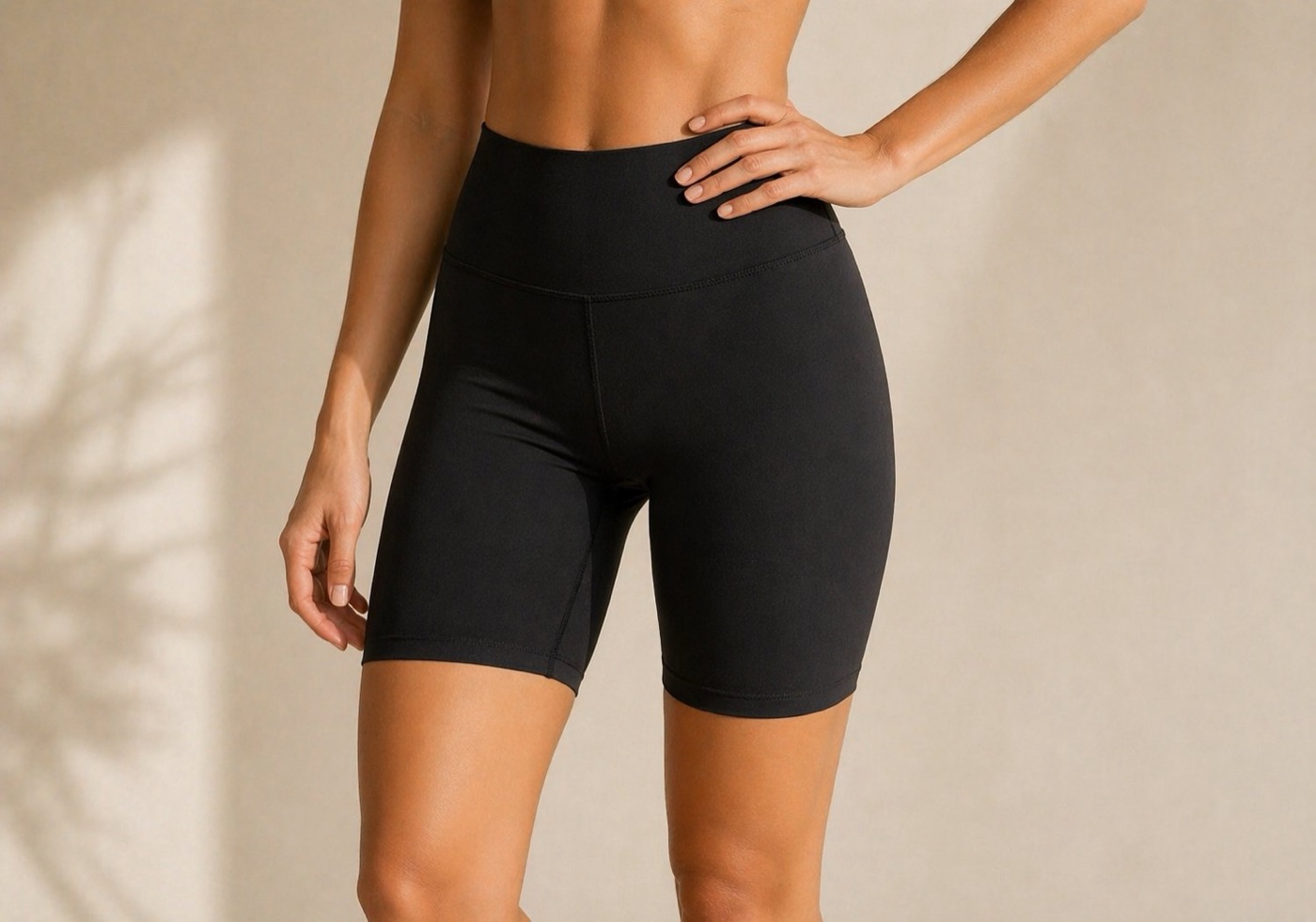
The four factory-level fixes
1. Remove the front centre seam. This is where seamless construction has a structural advantage: the garment is knitted as a tube, so there is simply no seam to pull in. In cut-and-sew, the equivalent is a shaped one-piece front panel.
2. Design the gusset properly. A diamond (rhombus) gusset moves the four-seam junction away from the front and gives the crotch area a flat fabric plane. The gusset should sit far enough back that its front point is not visible from a front view on a fit model.
3. Shape the front rise. A slightly deeper front rise with subtle dart or 3D shaping creates room instead of tension. On seamless machines this is done with knit-in density changes rather than cutting.
4. Put enough fabric there. Below about 200 GSM, stretched front panels thin out and follow every contour. Our catalog’s squat-proof-oriented leggings run 220–260 GSM in a 75/25 nylon-spandex double knit — dense enough to bridge, not cling.
The spec checklist
| Spec point | Safe zone | Where it lives |
|---|---|---|
| Front construction | No centre seam / knit-in front | Pattern & knitting program |
| Gusset | Diamond, junction set back | Pattern |
| Front rise | Deeper than back-rise-minus-2.5cm rule of thumb | Grading chart |
| Fabric weight | ≥220 GSM front panel | Fabric spec |
| Stretch balance | ~Equal warp/weft recovery | Fabric test report |
How to test it before bulk
Add a camel-toe check to your fit protocol: on at least two sizes, have the fit model squat, sit cross-legged, and step up under bright front lighting. Photograph each position. If anything prints, the fix order is: gusset position first, rise depth second, fabric weight third. This costs one extra fit round — a fraction of the cost of a viral complaint. Put the requirement in your tech pack so it is contractual, not optional.
How Yesseam handles it
Camel-toe prevention is baked into our seamless leggings blocks: tube-knitted fronts with no centre seam, set-back diamond gussets, and 220–260 GSM squat-proof fabric as the default for leggings. Every development sample goes through the squat-and-sit photo protocol before we cut bulk.
FAQ
What actually causes camel toe in leggings?
A front centre seam, a too-shallow front rise, a gusset set too far forward, or front fabric that is too light — usually two or more together. Under stretch the fabric plane is pulled against the body along the seam line and the silhouette prints through.
Are seamless leggings better against camel toe?
Structurally yes: a tube-knitted front has no centre seam to pull in, which removes the single biggest cause. You still need a proper gusset, adequate rise depth and enough fabric density — seamless is an advantage, not a guarantee.
Can an existing style be fixed without a full redesign?
Often. Moving the gusset junction back and deepening the front rise are pattern revisions that do not change the outside look of the garment. If the root cause is very light fabric, you will need a heavier knit — that is a fabric change, not a redesign.
Does a scrunch-bum design make camel toe worse?
It can, because centre-back ruching pulls the whole rise line rearward and tightens the front. Scrunch styles need extra front-rise allowance and a set-back gusset — covered in our scrunch leggings guide.
Developing this product?
Yesseam is a vertically integrated seamless activewear factory in Xiamen — in-house knitting, dyeing partners, sewing and QC, with stock programs from 50 pcs plain or 100 pcs with your logo, and custom development from 500 pcs. Send your idea or tech pack and we will come back with options and honest numbers within 24 hours.
Get a quote