Quick answer: Pick a support level first (light / medium / high), then match construction (compression, encapsulation or both), strap design, band and fabric to it. Seamless covers light to high support; cut-and-sew with encapsulation adds a route to high support in larger cup sizes.
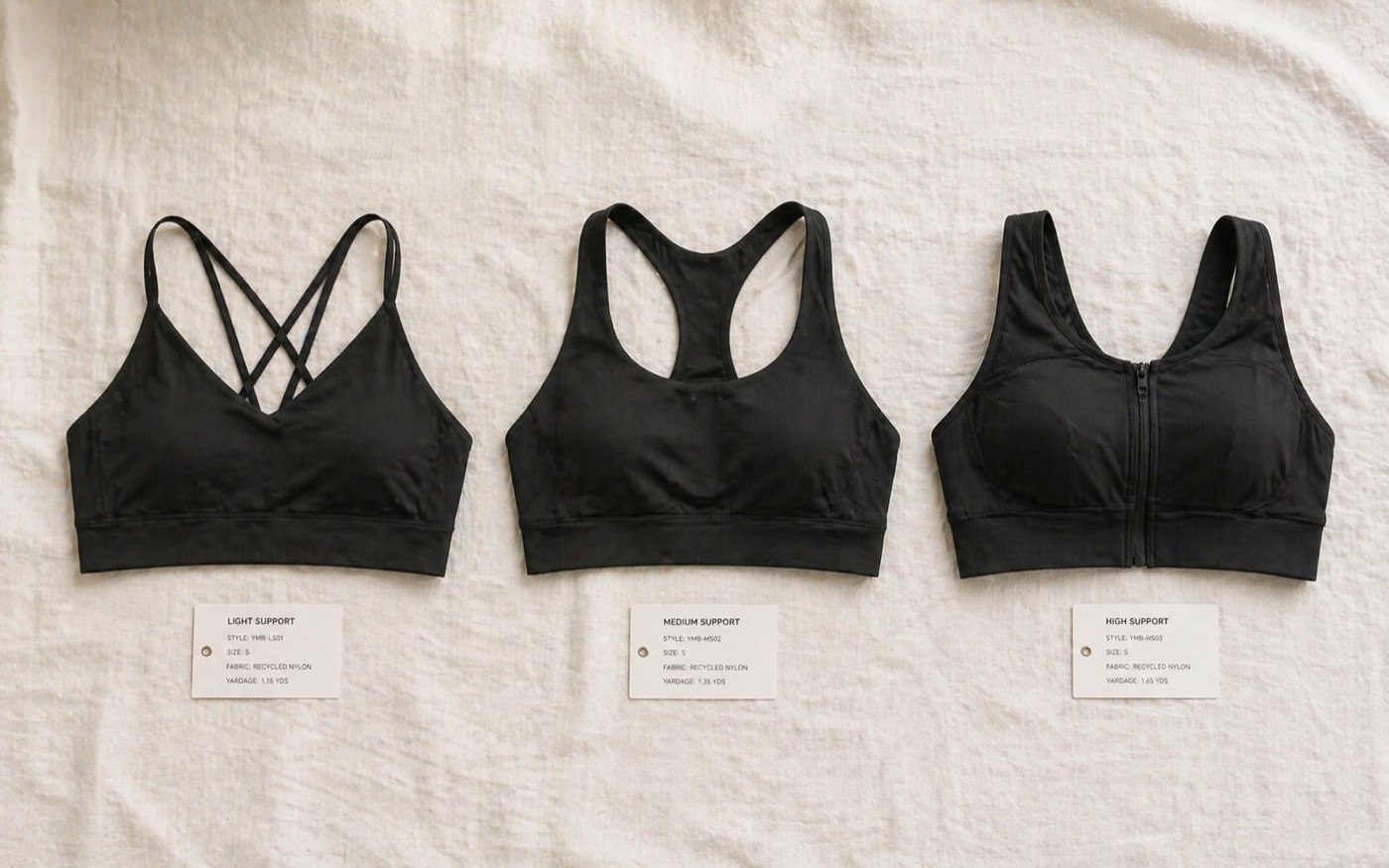
1. Choose a support level
- Light: yoga, pilates, lounge. Soft, pull-on, often seamless with a bralette feel.
- Medium: training, cycling, everyday. Compression + a supportive band.
- High: running, HIIT. Encapsulation (separate cups), wider band, adjustable straps, sometimes a hook closure.
2. Compression vs encapsulation
Compression presses the bust against the chest (simple, sleek, great for light–medium). Encapsulation supports each breast separately in shaped cups (best for high support and larger sizes). High-support bras often combine both.
3. Straps, band & closure
The band does most of the support — make it firm and wide enough. Strappy backs look great for light support; racerback and adjustable straps add security for high impact. Removable pads keep it clean and washable.
4. Fabric & seamless option
220–280 GSM with good recovery. Seamless gives a smooth, chafe-free bralette; cut-and-sew lets you add encapsulation, power mesh lining and structured bands.
5. Fit-test before bulk
Test on real bodies across the size run: jump test for bounce, raise arms (band shouldn't ride up), check edges don't dig. Iterate the sample until it passes.
Start with the support decision, not the look
Every real bra design brief starts with one question: what movement is this for? Light support (yoga, pilates, lounge) allows strappy backs, pull-over entry and softer knits. Medium support (training, spin, gym floor) needs a firmer underband, higher-compression knit zones and less strap elasticity. High support for running and HIIT can be knitted seamless, with a denser knit and a taller underband; larger cup sizes that need encapsulation, molded cups or hook closures move to cut-and-sew or a hybrid. Decide the level first; every later choice (knit map, strap width, band height) hangs off it. A "beautiful" bra at the wrong support level generates the worst reviews in activewear.
Anatomy of a seamless bra, piece by piece
Underband: the engine of support — deeper bands (5–7 cm) with high-density knit hold without digging; test it can bear the bounce load alone. Straps: width trades comfort against style; racerbacks centralise load, crossbacks look great on the rack but must be tack-checked so they don't slide. Knit zones: a good seamless bra alternates high-compression panels (under bust, side wings) with breathable lighter zones (center chest, upper back) — engineered in the knit map, not sewn on. Pad pockets: removable pads via internal openings are standard; specify pad shape (round vs contour) because it changes the neckline drape. Finish: bonded or plush-elastic edges prevent the red-mark complaints that dominate bra reviews.
The fit-testing protocol that predicts reviews
Test on at least two real bodies per size point, not one fit model. The sequence: static check (band level front-to-back, no gap at center front, straps flat), then the bounce protocol — 60 seconds of jumping jacks, then check band migration and strap slip; then overhead reach (band should not ride more than 2 cm); then the strip test — marks on skin after 20 minutes indicate edge pressure that will read as "digs in" in reviews. Log everything against the spec, change one variable per round, and re-test. Two disciplined rounds beat four chaotic ones.
Grading and the size-range call
Seamless grading is knit-programmed, so extending your range is cheaper than in cut-and-sew — but grade the support, not just the girth: larger sizes need proportionally deeper bands and wider straps, not a scaled-up small. Most of our bra styles run S–XL with XXL+ available on the same knit map. If you serve above a D-cup equivalent seriously, plan a separate high-support style rather than stretching a light design — the sports bra manufacturing guide covers where seamless ends and structured construction begins.
Yarn and zone choices that make or break comfort
Bra comfort is engineered at the yarn level. The underband wants high-density knit with firm recovery yarns — it should stretch to get on, then hold without creep. Wings and back panels alternate compression with ventilation zones; in seamless these are knit-mapped, replacing the sewn power-mesh of cut-and-sew construction. Next-to-skin softness comes from finer-denier nylon on the inner face. Specify moisture behaviour too: underband sweat is the top comfort complaint in hot-climate reviews, and a wicking inner layer plus ventilated under-bust zone addresses it at the knit map, free, rather than at the marketing department, expensively.
The bra development timeline, honestly
Bras develop slower than leggings — plan for it. A realistic ODM path: week 1 style selection and support-level brief; weeks 2–3 first sample; weeks 3–4 wear-testing across two body types and one consolidated comment round; weeks 5–6 second sample plus lab dips; week 7 PP approval; then ~30 days bulk. That is roughly two and a half months door-to-door, one extra fit round more than bottoms — because band pressure and bounce control can't be judged on a hanger. Compress it by testing rigorously in round one, never by skipping the wear test.
FAQ
What is the difference between compression and encapsulation sports bras?
Compression presses the bust to the chest (light–medium support); encapsulation supports each breast in separate cups (high support). Many high-impact bras use both.
What support level do I need?
Light for yoga/lounge, medium for training, high for running and HIIT — match construction, band and straps to the level.